
Orthodontics for children
An initial orthodontic assessment at around the age of 7 can help to identify, at an early stage, any problems that might later require longer and more complex treatment.
Your child may not need braces straight away. However, an early screening can reveal trends in jaw development, tooth replacement and bite alignment that are much easier to manage if addressed in good time.
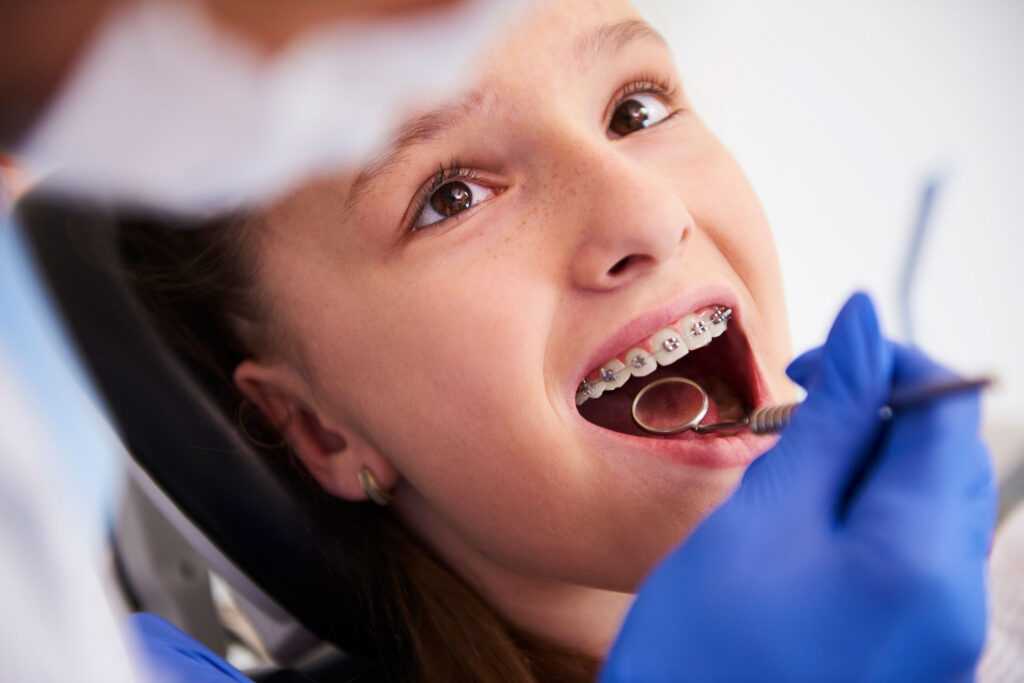
You don’t have to wait until all your milk teeth have fallen out
Many parents still harbour the misconception that orthodontic treatment is only worthwhile once all the milk teeth have fallen out. This view is now outdated and can often lead to the need for longer, more complex treatment during the teenage years.
Based on international professional guidelines It is advisable to have the first orthodontic screening carried out at around the age of 7. This does not mean that the child will be fitted with braces straight away, but at this age the growth patterns of the jawbones, the process of tooth replacement and any developing malocclusions are already clearly visible.
Warning signs
When should parents seek professional help?
Although regular screening is the most reliable approach, it is advisable to seek advice as soon as possible if you notice any of the following warning signs:
Age of milk teeth
loss of milk teeth that is too early or unusually late
Eruption abnormalities
permanent teeth that have erupted in a crowded, rotated or malpositioned manner
Bite discrepancies
visible malocclusion (e.g. the lower teeth bite in front of the upper teeth, or the incisors protrude too far)
Harmful habits
thumb-sucking, tongue-thrust swallowing even after the age of 3–4
Breathing patterns
frequent mouth breathing, snoring, sleeping with an open mouth
Facial paralysis
visibly asymmetrical facial development, a jaw that has shifted forwards or backwards
Functional problems
problems with chewing or difficulty biting
Our paediatric orthodontic solutions
at Gere Dental
Removable orthodontic appliances
Removable appliances are primarily used for children who are still growing. Their main advantage is that, as well as correcting the position of the teeth, they also guide the development of the jawbones in the right direction, making use of the natural phases of bone growth.
What problem does it solve?
It corrects any imbalances between the developing jawbones, widens the dental arch and creates space for the permanent teeth to come through.
How does it work?
The child wears the appliance for the number of hours per day prescribed by the doctor (usually in the afternoon and at night). The key to successful treatment is regular use and parental cooperation.
When can it be used?
Particularly during the mixed dentition stage (between the ages of 6 and 12).
U Concept® Myofunctional Trainers
At our practice, we use state-of-the-art U Concept® myofunctional trainers, which do not merely focus on the symptomatic correction of the teeth, but also address the muscular dysfunction and harmful habits that cause dental irregularities.
What problem does it solve?
It helps to correct mouth breathing, tongue-thrust swallowing and the effects of thumb-sucking; it contributes to the development of correct tongue positioning and nasal breathing, whilst supporting the harmonious development of the jawbones.
How does it work?
The soft, silicone-based trainer should be worn by the child for just 1–2 hours a day whilst awake, as well as at night whilst sleeping. It restores the balance of the muscles around the mouth, thereby guiding the teeth into the correct position naturally.
When can it be used?
Ideally, treatment can begin as early as the age of 4–10, which can prevent or significantly simplify the need for orthodontic treatment later in adolescence.
D-Gainer fixed appliance (for mixed dentition)
The D-Gainer is a special fixed orthodontic appliance designed specifically for children with mixed dentition. It is bonded exclusively to permanent teeth that have already erupted, so it acts locally without covering the entire dental arch.
What problem does it solve?
It resolves severe space deficiency, widens the dental arch, ensures there is sufficient space for the permanent teeth still developing in the gums, and drastically reduces the likelihood of tooth extraction in adulthood.
How does it work?
As it is a fixed device, it exerts its effect continuously and gently. Thanks to its small size, it is extremely convenient and does not require any specific cooperation from the child (they cannot lose it or forget to put it on).
When can it be used?
During the mixed dentition stage, when the first permanent molars and incisors have already emerged.
Book an appointment today!
We look forward to welcoming you to our two modern clinics in Budapest. Choose a location, a doctor or a service, and book your appointment online – it’s quick and easy!