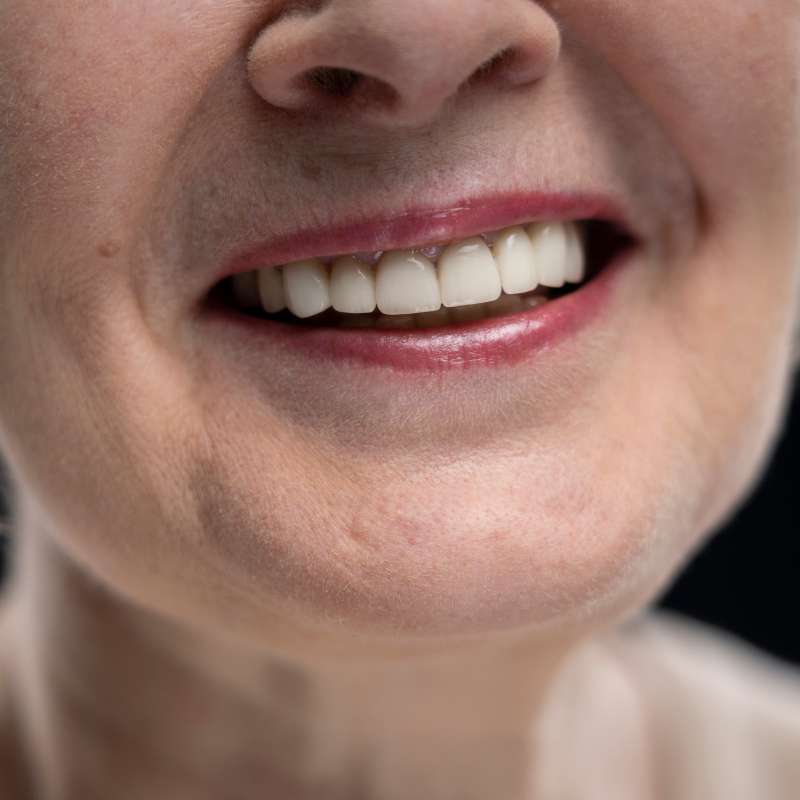
At Gere Dental’s clinics in Budapest, we use state-of-the-art, metal-free materials, digital 3D design and a team of renowned dental technicians. With us, you won’t have to worry about those unpleasant, gag-inducing traditional impressions: we map your oral cavity using a pain-free 3D intraoral scanner, and we provide a temporary restoration whilst your permanent restoration is being made, so you won’t be without teeth for a single day.
What problems do our prosthetic treatments help to resolve?
Severely damaged, decayed or broken teeth
To protect and strengthen a tooth following root canal treatment or significant tooth structure loss.
One or more missing teeth
To replace missing teeth, restore chewing function and prevent the remaining teeth from shifting.
Complete or extensive tooth loss
Creating attractive, durable and practical restorations for a confident everyday life.
Our prosthetic solutions at Gere Dental
Aesthetic zirconia and ceramic crowns
What problem does it solve?
It restores the shape, colour and chewing function of severely damaged, fractured or root-canal-treated teeth, preventing the tooth from cracking or breaking.
How do we go about it?
Under local anaesthetic, we carefully prepare (grind down) the tooth – preserving as much of the natural tooth structure as possible. We then take a scan using a digital 3D scanner. The laboratory uses computer-aided design and manufacturing (CAD/CAM) to mill the crown, which we then try on precisely in the surgery before cementing it in place.
Duration of treatment
Usually 2 appointments; the whole process takes 1–1.5 weeks (we provide a temporary crown to bridge the gap).
Dental bridge
What problem does it solve?
It corrects tooth loss, restores full chewing function, and prevents adjacent teeth from tilting or the opposing teeth from protruding.
How do we go about it?
We prepare the abutment teeth flanking the gap under local anaesthetic, digitally model them using a 3D scanner, and then permanently cement the metal-free or ceramic bridge, fabricated by the dental laboratory, into place.
Duration of treatment
It takes 2–3 visits and is fully completed in around 1.5–2 weeks.
Removable dentures
What problem does it solve?
In cases of extensive tooth loss or complete edentulism, it restores the joy of chewing, speaking and smiling.
How do we go about it?
- Partial removable denture: It is attached to the remaining natural teeth using hidden, invisible precision-engineered retainers (sliders) or clasps.
- Full removable dentures: These are secured with precision to the mucosal-osseous base using a vacuum-seal mechanism.
- Implant-supported removable dentures: The denture is secured to 2–4 implants using a special component (e.g. a clasp or bar). This solution remains firmly in place whilst chewing or speaking, providing a maximum sense of security.
Duration of treatment
To ensure a precise fit and an attractive finish, the process requires 3–4 appointments (impressions, bite adjustment, wax try-in), and the production time is approximately 2–3 weeks.
Frequently Asked Questions
Is the preparation for a dental restoration or the grinding process painful?
Not at all. We carry out all preparatory work and procedures under effective local anaesthetic, so the process is completely pain-free.
Will it be obvious that I have a crown or a bridge?
No. The metal-free zirconia and E.max ceramics used at Gere Dental have the same refractive index and translucency as natural teeth, so nobody will notice the difference.
Will I be left without teeth whilst my permanent dental prosthesis is being made?
No! We always fit a temporary crown or restoration whilst the dental work is being carried out, so you can smile and eat with confidence throughout your treatment.