Clear aligners have revolutionised orthodontics in recent years. More and more people are opting for this state-of-the-art solution, as it is discreet, comfortable and easy to incorporate into everyday life. The Smilezor system is based on modern digital technology, which enables the teeth to be moved gradually and precisely, whilst the treatment remains virtually unnoticeable.
In this article, we’ll guide you through the entire Smilezor treatment process, from the initial consultation right through to the stunning end result.
What is Smilezor?
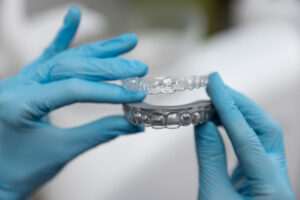
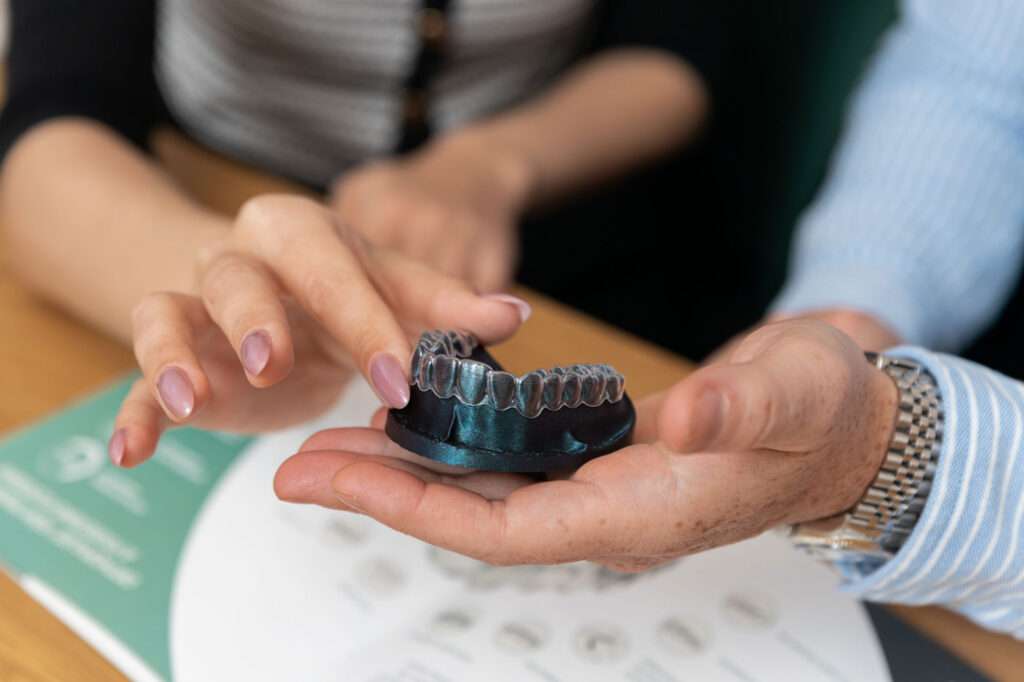
Smilezor is a clear aligner system that straightens teeth using bespoke, individually manufactured aligners. The aligners are made from high-quality, multi-layered clear medical-grade material, making them virtually invisible when worn. The Smilezor system is a Hungarian-made device, manufactured in Hungary by Hungarian specialists. Furthermore, one of its greatest advantages is that not only is your treating dentist involved in the planning process, but so is an orthodontist working at the Smilezor centre. As a result, several highly qualified orthodontists determine the method of tooth movement.
Unlike traditional metal braces, Smilezor aligners:
- almost invisible
- comfortable
- can be removed for meals and toothbrushing
- do not contain any metal parts
- enable digitally planned, predictable treatment.
1. Initial consultation and digital fingerprinting.
Treatment always begins with a detailed orthodontic consultation.
During this process, our specialist:
- examines the teeth and bite
- assesses aesthetic and functional issues
- discusses the patient’s expectations
- decides whether Smilezor is the right solution in the given case.
X-rays are taken during the first consultation. In the surgery, photographs of the teeth and face are taken in accordance with a set protocol; these will be essential for the specialists during the precise planning stage.
Digital fingerprinting
Instead of taking traditional impressions, we use a modern intraoral scanner to take digital impressions at our practice.
The advantages of this are:
- fast
- comfortable
- extremely accurate
- There are no unpleasant printing materials.
The scan takes just a few minutes to complete and produces a three-dimensional digital model of the teeth. One major advantage of digital impressions, which is rarely mentioned, is that it allows the patient to visualise their current bite in three dimensions. This helps them to work with their dentist to set goals and determine the treatment plan.
In most cases, the initial consultation and the digital impression-taking take place at the same appointment.
2. Drawing up the treatment plan
The personalised treatment plan is drawn up based on the digital models. The plans can be viewed during the second consultation. At this stage, the treating dentist will present the digital plan visually. One of Smilezor’s greatest advantages is that the expected movement of the teeth can be planned in advance using computer simulation. Thanks to this, the patient can see how their smile will change even before treatment begins. They can also see how long the treatment will take and what the financial implications are.
When reviewing the plans, there is an opportunity to discuss in detail what is shown in the plans, and to make changes to them should the patient and the attending doctor wish to do so.
TIP: When reviewing the treatment plans, it is worth asking your treating doctor any questions you may have about the plan or your treatment. Furthermore, if the plan does not meet your expectations, please discuss this with your treating doctor and ask for it to be amended.
4. Making the rails
The entire set of rails will be manufactured in accordance with the approved management plan.
Each aligner represents a very small step towards the desired tooth position. The aligners move the teeth gradually, one after the other.
During the manufacturing process, high-precision digital technology ensures that every rail fits perfectly.
5. Starting treatment
When the aligners are handed over, our dentist will explain in detail how to use them.
It is generally recommended that:
- to wear the splints for 20–22 hours a day,
- only to be removed for meals and when brushing your teeth,
- to replace the rails at the prescribed intervals.
- Handling any attachments and IPRs
The greatest advantage of invisible aligners is that they can be removed; however, if medical instructions are not followed, the effectiveness of the treatment will be reduced. One of the most important factors in the success of the treatment is the patient’s cooperation and consistent wearing of the aligners.
6. Follow-up examinations
With invisible braces, follow-up appointments are generally required less frequently than with traditional fixed braces. Nevertheless, regular check-ups are an important part of the treatment, as they allow the treating dentist to ensure that the teeth are moving in accordance with the treatment plan and that the orthodontic treatment is progressing at the planned rate.
On these occasions, we check:
- whether the teeth are moving as they should,
- whether the rails fit properly,
- Is an amendment required,
- whether oral hygiene is adequate.
7. Completion of treatment
Once the teeth have reached the desired position, the treatment is complete.
However, this does not mean that there is nothing else to be done from this point onwards.
8. Retention: maintaining the results
Teeth naturally tend to move back towards their original position.
To prevent this, it is necessary to wear a retainer.
This could happen:
- with a transparent retention splint,
- or with a fixed retainer.
Retention is at least as important a part of treatment as orthodontic treatment itself, as it ensures a stable result in the long term.
What problems can be treated with Smilezor?
Smilezor is suitable for treating a wide range of orthodontic problems, such as:
- crowded teeth,
- gaps between the teeth,
- mild or moderate malocclusions,
- cross-bite,
- deep bite,
- open bite,
- dental arch narrowing.
Treatment options can only be determined on a case-by-case basis following an individual assessment.
How long does the treatment take?
The duration of treatment depends primarily on the extent of the deviation.
In general:
- minor adjustments: 3–6 months,
- moderate treatments: 6–12 months,
- more complex cases: 12–24 months.
The exact treatment duration can be determined once the digital treatment plan has been drawn up.
The benefits of Smilezor treatment
Smilezor is a modern orthodontic solution that offers a number of benefits:
- an almost invisible appearance,
- comfortable to wear,
- removable rails,
- easier oral care,
- digitally planned treatment,
- predictable results,
- fewer check-ups at the surgery,
- a high standard of aesthetics.
Frequently Asked Questions
Is the treatment painful?
When the new braces are fitted, you may experience a slight feeling of tightness, which indicates that your teeth are moving. This usually subsides within a few days.
Is it allowed to eat on the tracks?
No. You must remove the aligners before meals and put them back in after brushing your teeth.
How long should you wear it each day?
For best results, it is recommended that you wear it for 20–22 hours a day.
Who is suitable for Smilezor treatment?
It may be a suitable option for most adults and many teenagers too; however, a face-to-face consultation is always required to determine whether it is appropriate.
Summary
Smilezor is a state-of-the-art orthodontic system based on digital technology, offering a comfortable, aesthetic and effective alternative to traditional braces. Thanks to precise treatment planning, custom-made aligners and regular check-ups, predictable and stable results can be achieved.
If you’d like to find out whether Smilezor is the right choice for you, please book a personal consultation at our clinic. Following a detailed examination, our specialists will draw up a personalised treatment plan so that you, too, can smile with confidence.