When someone starts treatment with clear aligners, they often come across the term ‘attachment’. Many people are put off by the term at first, even though it is a completely natural and important part of the treatment. Attachments help the aligners to move the teeth even more precisely and effectively.
What is an attachment?
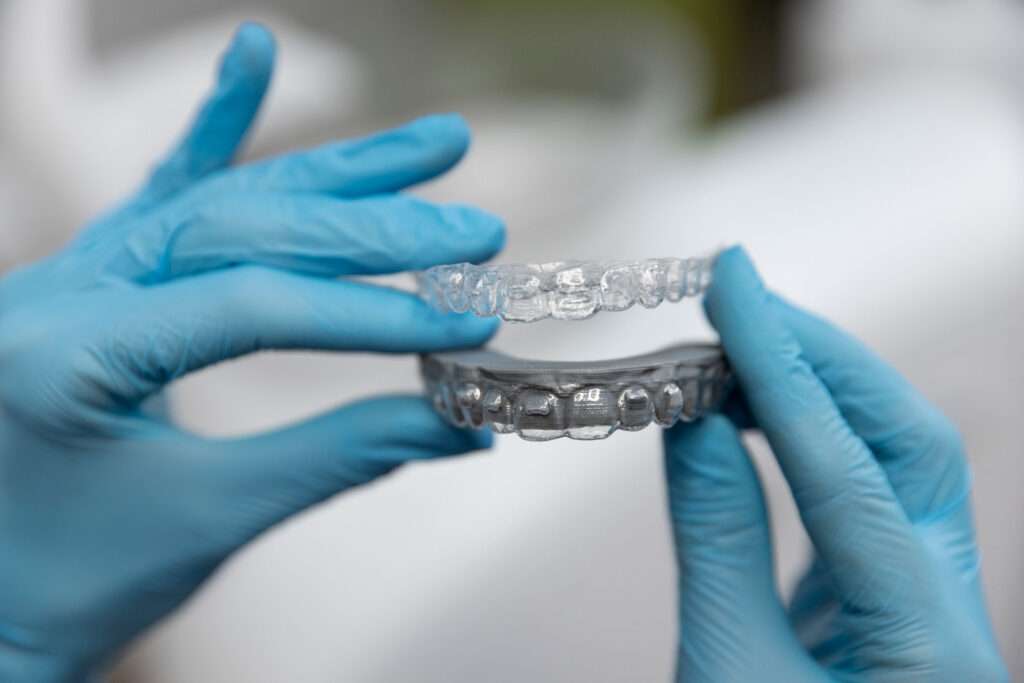
An attachment is a small, tooth-coloured composite element that the dentist bonds to the surface of the tooth. Its colour matches the natural shade of the tooth, so it is barely noticeable when worn.
They are usually only a few millimetres in size and are always custom-made to suit the direction in which the tooth in question needs to be moved.
Why is it necessary?
The transparent aligners move the teeth gradually and gently. However, certain movements of the teeth would not be sufficiently precise or effective if achieved solely by the aligners.
In such cases, the attachments act as tiny “anchors” for the rail, thereby enabling even more complex tooth movements.
With their help, for example:
- the teeth can be rotated more precisely,
- the roots can be moved more effectively,
- the gaps between the teeth are easier to close,
- Even more complex bite problems can be treated.
As a result, treatment becomes more predictable and effective.
Is an attachment fitted to every tooth?
No. The number and location of the attachments vary from patient to patient.
There are simpler cases where attachments are only required on a few teeth, whilst in more complex treatments they may be placed on several teeth. The treating dentist and the digital treatment plan determine which teeth they are placed on.
Does it hurt to have the attachment fitted?
No. The attachment procedure is completely painless.
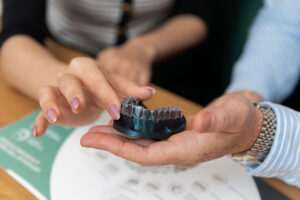
The dentist uses a special template to fix them precisely in the right place. The whole process can usually be completed in a short time, and no anaesthetic is required.
Can you eat and brush your teeth with them?
Yes. The attachments are securely fixed to the tooth, so they do not interfere with everyday life.
However, good oral hygiene is important, so it is recommended that you brush your teeth thoroughly after every meal before putting the aligners back in.
What happens at the end of the treatment?
Once orthodontic treatment is complete, the dentist will remove the attachments in a matter of minutes. This is a painless procedure, during which the surface of the teeth is also polished, restoring them to their original smoothness.
Summary
Despite their small size, attachments play an extremely important role in clear aligner treatment. With their help, the aligners can move the teeth more effectively and precisely, making the outcome of the treatment more predictable and reliable. Although their presence may seem unusual at first, most patients get used to them completely within a few days.