
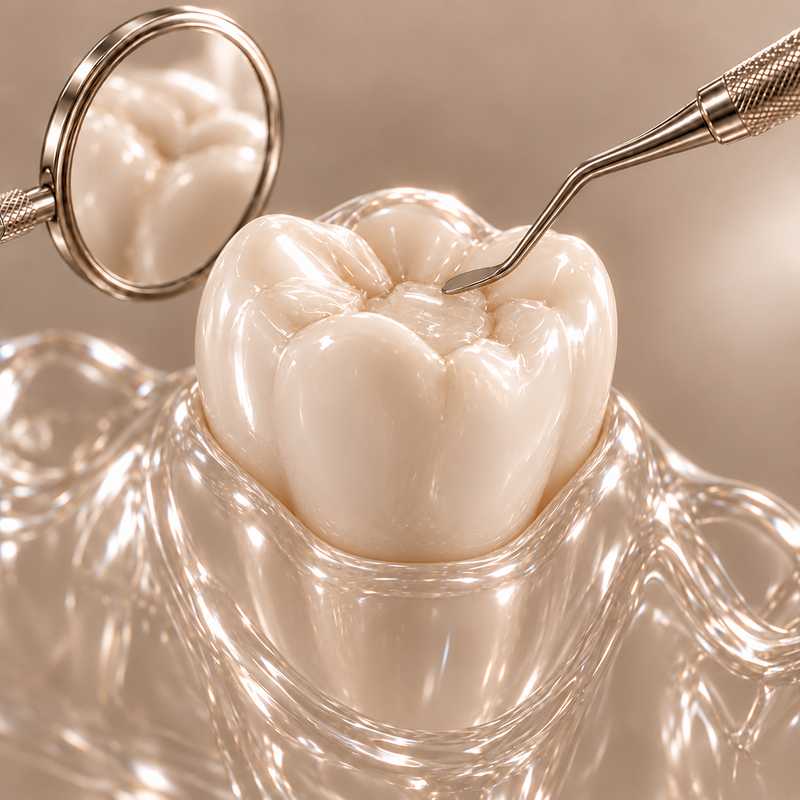
The first and most important principle of modern dentistry is that your own teeth are the best teeth. The primary aim of conservative (tooth-preserving) dentistry is to prevent further damage to the teeth, halt tooth decay, save teeth that are already deeply affected from extraction, and to restore them to their original shape in a way that is aesthetically imperceptible.
At Gere Dental’s clinics in Budapest (in the 13th and 16th districts), we follow the principles of minimally invasive dentistry (which maximises the preservation of natural tooth structure). We work with top-of-the-range, light-curing composite materials, computer-assisted root canal technology and digital precision. All our procedures are carried out under effective local anaesthesia, ensuring that treatments are completely pain-free and comfortable.
What problems do our preservation treatments address?
Early-stage and more advanced tooth decay
Removal and sealing of damaged tooth tissue to protect the pulp.
Severe, throbbing toothache or an abscess
Treatment of a deep infection affecting the pulp and preservation of the natural tooth in the oral cavity.
Minor aesthetic imperfections in the front teeth
Correction of chipped tooth edges, gaps between teeth (diastema) or stubborn discolouration in a single session.
Our preventive treatments at Gere Dental
Cosmetic dental fillings
What problem does it solve?
It stops the spread of tooth decay, protects the dental pulp from infection, eliminates sensitivity to hot and cold, and restores the tooth’s chewing function.
How do we go about it?
The procedure is completely painless; we clean the affected area under local anaesthetic. Once the cavity has been prepared, we build up the filling layer by layer using premium micro-hybrid composite, then cure it with a special light. Finally, we polish the surface until it is smooth and comfortable.
Duration of treatment
Depending on the extent of the decay, it takes approximately 30–50 minutes per tooth.
Root canal treatment
What problem does it solve?
It relieves excruciating toothache, inflammation or an abscess around the root tip, and prevents the tooth from having to be extracted.
How do we go about it?
After thorough anaesthesia, we open up the tooth. Using modern mechanical reamers and a digital apex locator, we clean and rinse the root canals to an accuracy of a tenth of a millimetre. We seal the disinfected root canals with a medicated filling, followed by a permanent, hermetically sealed root filling.
Duration of treatment
Depending on the number of root canals and the extent of the inflammation, the treatment requires one or two appointments, each lasting approximately 60–90 minutes.
Direct veneers (Composite veneers)
What problem does it solve?
It corrects minor chips on the front teeth, gaps between the teeth, asymmetry in shape, or deep discolouration that cannot be removed by teeth whitening.
How do we go about it?
It requires little or no tooth preparation, thus providing maximum protection for the natural tooth structure. The dentist uses fine brushes to shape the new form and colour gradient on the tooth surface layer by layer, which is then polished to a high gloss after light curing.
Duration of treatment
It takes just 60–90 minutes per tooth, and the results are visible straight away.
Frequently Asked Questions
Will root canal treatment hurt?
Not at all. Thanks to modern anaesthetic techniques, root canal treatment is now no more uncomfortable than a simple filling. The aim of the treatment is precisely to provide immediate relief from excruciating pain.
How visible are composite fillings and direct restorations?
They’re completely invisible! We work with such a wide range of colours and translucent materials that they perfectly mimic natural enamel and dentine.
How long can a tooth that has undergone root canal treatment last?
A root-canal-treated tooth that has been professionally cleaned, hermetically sealed and subsequently reinforced with a crown or an inlay/onlay can remain in your mouth for the rest of your life.