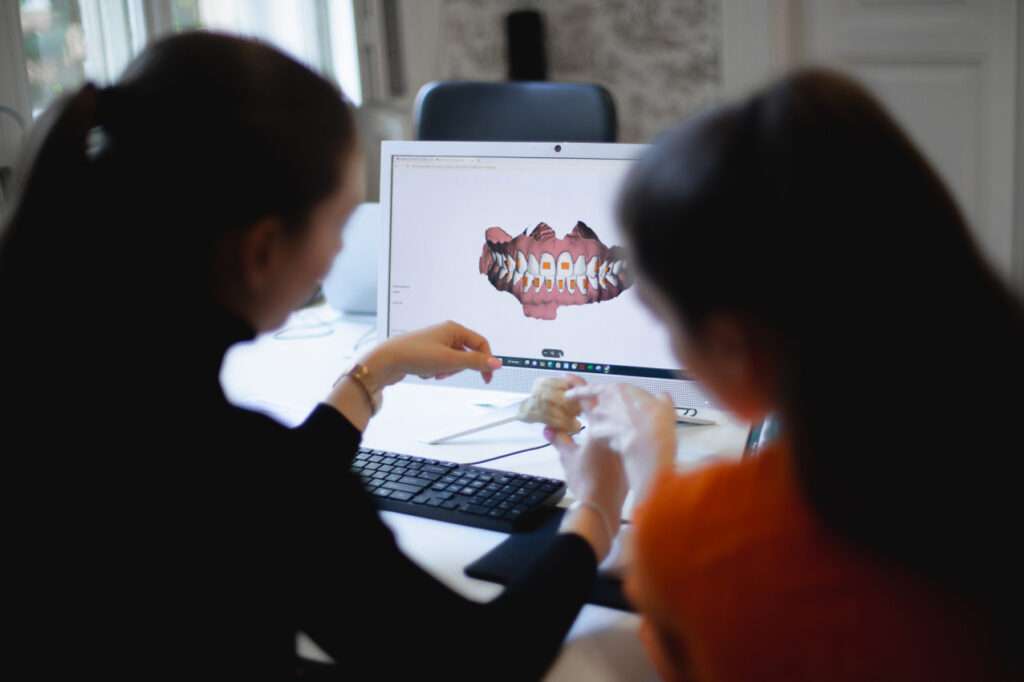
Orthodontic treatment is a complex process, the primary aim of which is to move the teeth into the correct position. Orthodontic treatment may be required for a number of reasons, such as cosmetic correction, malocclusion, crowded teeth, or difficulties with chewing and speech; however, there are also countless other individual factors that may warrant treatment.
Whilst there may be differences between individual orthodontic appliances in terms of the forces they exert on the teeth, the movement of the teeth within the body always takes place in a specific way: through bone remodelling. This is why the teeth can be safely and gradually moved into their new, ideal positions.
Did you know?
Teeth can be moved not only by orthodontic appliances; sometimes this is caused by the eruption of a wisdom tooth, or even by a bad habit, such as thumb-sucking or tongue-thrusting.
Orthodontic treatment, by contrast, is a controlled, pre-planned process carried out with a specific aim in mind.
Teeth do not grow rigidly into the bone
Between the root of the tooth and the jawbone lies an extremely thin layer of connective tissue known as the periodontal ligament (PDL). This ligament provides a flexible connection between the tooth and the bone, and allows the teeth to move under controlled forces.
When the orthodontic appliance exerts a gentle, continuous force on a tooth, one side of the periodontal ligament is compressed, whilst the other side is stretched. This triggers the biological processes that underpin tooth movement.
How does a tooth move?
In response to pressure, the body activates specialised cells (osteoclasts – cells that break down bone, and osteoblasts – cells that build bone)
On the side where the braces are moving the tooth, cells known as osteoclasts break down part of the bone, thereby creating space for the tooth. At the same time, on the other side – where the appliance is moving the tooth – osteoblasts build new bone, which firmly anchors the tooth in its new position.
This continuous process of bone resorption and bone formation is known as bone remodelling, and it is what enables the teeth to move without causing any damage.
Why can’t teeth be moved any faster?
Why can’t teeth be moved any faster?
For patients, speed is usually one of the most important considerations in orthodontic treatment. Of course, it is perfectly understandable that, as a patient, you would want to get the treatment over and done with as soon as possible; however, biological processes should not be rushed. Faster movement would require greater force, which triggers precisely the opposite processes. It can increase discomfort, slow down bone remodelling and increase the risk of root resorption. Orthodontic appliances and treatment plans are designed with these factors in mind and exert a continuous, even force on the teeth.
There are now modern, gentle technologies available for safe acceleration: the OrthoPulse 2.0 device, for example, which uses specialised light therapy, stimulates cellular metabolism, thereby making tooth movement more effective and comfortable on a biological basis.
How do invisible braces work, and why do the aligners need to be replaced regularly?
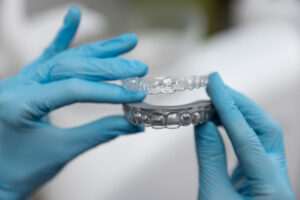
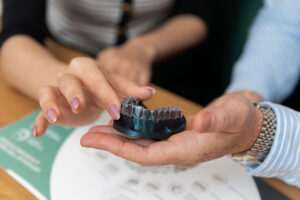
Each of the Smilezor invisible aligners is designed to make a small adjustment. Each aligner typically moves the teeth by a few tenths of a millimetre, and once the teeth have reached their intended position, the next aligner takes over.
This gradual approach ensures that the teeth, bone and surrounding tissues can adapt at an appropriate pace.
What happens after treatment has finished?
Once the teeth have reached their new position, they cannot yet be considered completely stable. The surrounding bone and the fibres of the periodontal ligament need time to adapt fully to the new situation; therefore, all orthodontic treatment is followed by a retention period.
Summary
During orthodontic treatment, a process known as bone remodelling takes place within the body. All orthodontic appliances, whether they are invisible aligners or fixed braces, are designed to support this process. Orthodontic treatment takes time; there are certain things that cannot be rushed, as the body needs time to adapt to the changes.
It is therefore important that treatment is always carried out with proper planning and regular monitoring, as precise biomechanics and the body’s natural adaptation form the basis for long-term, stable results.